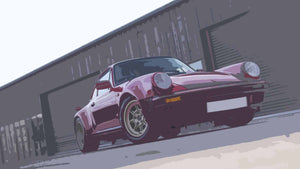


The Porsche 944 is easy to recognise before you know much about it: the broad wings, pop-up headlights and glass rear hatch give it a shape that still looks purposeful today.
Its place in Porsche history is more interesting than the familiar description of an affordable alternative to a 911. The 944 belonged to a period when the company was exploring a different sports-car formula, with a water-cooled engine at the front and the gearbox at the rear.
Over its life, that formula produced quite a family: eight-valve road cars, the 16-valve S and S2, Turbo models and open-top versions. Understanding how they arrived makes the differences between the cars much easier to appreciate.
I have owned several 944s, including a 1988 944 S. For me, the attraction has always been the car's own character, rather than how closely it resembles another Porsche. Here is how that character developed.
Porsche 944 history at a glance
| Date | What happened |
|---|---|
| 1976 | The production 924 establishes Porsche's water-cooled, front-engine transaxle approach. |
| September 1981 | The 944 is unveiled, positioned between the 924 and 911. |
| 1982 model range | The original 2.5-litre 944 begins the road-car story familiar to buyers. |
| 1985 | A revised cabin appears, and Porsche introduces the Turbo. |
| Model years 1987–1988 | The 2.5-litre, 16-valve 944 S joins the range. |
| Model year 1988 | The higher-output Turbo S arrives. |
| Model year 1989 | The eight-valve engine grows to 2.7 litres; the 3.0-litre S2 succeeds the S; the regular Turbo gains the Turbo S engine. The S2 also brings a production Cabriolet. |
| 1991 | The Turbo Cabriolet appears, 944 production ends and the successor 968 is unveiled. |
This is an overview of the model family. Announcements, production changes, model years and first registrations do not always share a date, and local availability differed. A North American advert may describe a car differently from a European model-history reference.
In this guide
- Why the transaxle idea mattered
- The 924 roots and 944 identity
- The Porsche-designed four-cylinder engine
- How the range evolved
- A place in Porsche's racing story
- The transition to the 968
- Why the 944 still appeals
- Thinking of owning one?
1. Why the transaxle idea mattered
For a brand so closely associated with the rear-engined 911, the transaxle cars represented a different route. In simple terms, the engine sat at the front while the transmission was at the rear axle.
Porsche introduced that production arrangement with the 924 in 1976. The larger V8-powered 928 followed, and the 944 and 968 continued the idea in four-cylinder form.
The layout is part of what makes these cars interesting, but it does not make their experiences identical. A 928 grand tourer and a 944 are different propositions. Their shared architecture belongs to a broader chapter in Porsche history, rather than a single attempt to reproduce the 911 with the engine moved.
That is a useful way to approach a 944 today: give it room to be its own car.
2. The 924 provided the foundation; the 944 found its own identity
Porsche unveiled the 944 in September 1981, placing it between the 924 and the 911. It did not immediately sweep the 924 out of the showroom; the two model lines overlapped.
The relationship is visible in the roofline and hatchback profile, but the 944's wider, more muscular wings gave it a distinct stance. It looked like a development of a familiar idea with greater sporting emphasis.
The early interior also retained its 924 connection. The more distinctive revised 944 cabin came later: Porsche's model reference dates that change from January 1985. An early car and a later one therefore offer different surroundings even before you compare engines.
For an enthusiast, that is part of the appeal of following the history. The model was not one fixed specification waiting for a Turbo badge. It developed in several directions.
3. A Porsche-designed four-cylinder engine
The original 944's centrepiece was its newly developed 2.5-litre, naturally aspirated inline-four. Porsche describes its design as based on the right-hand cylinder bank of the 928's V8, with two balance shafts contributing to smooth running.
That connection explains the familiar “half a 928 engine” description, but it is best understood as an engineering relationship, not a literal account of taking a V8 and cutting it in two.
The engine helped distinguish the 944 from its predecessor. Porsche positioned the new car between its existing models in performance and price, giving buyers another way into the range without asking it to have the same character as the 911.
Power figures require care in any history of the 944. Market specifications changed, and PS, bhp and US horsepower are not interchangeable labels. The figures below use Porsche's European reference values in PS, or metric horsepower; they are not specifications for every car sold worldwide.
4. How the 944 range evolved
The Turbo: a different expression of the same idea
Porsche introduced the 944 Turbo in 1985. Its smoother front treatment distinguished it from the original car, and the turbocharged 2.5-litre engine was rated at 220 PS in Porsche's reference history.
The 1988-model-year Turbo S increased that to 250 PS. From model year 1989, the regular Turbo received that higher-output engine too. A 250 PS claim alone therefore does not identify a car as a Turbo S.
It is easy for the Turbo to dominate the story, but the naturally aspirated range continued to develop alongside it.
The S: sixteen valves
The 944 S, listed for model years 1987–1988, retained 2.5 litres but introduced a 16-valve engine, with a European reference output of 190 PS.
This was the version I owned in 1988 specification. Its place in the family matters: the S was a separate naturally aspirated development, rather than simply a Turbo alternative with the extra equipment removed.
The 2.7 and S2: two developments for model year 1989
The eight-valve car's engine grew to 2.7 litres for model year 1989. Meanwhile, the S2 succeeded the S with a 3.0-litre, 16-valve engine rated at 211 PS in Porsche's European history.
The S2 also adopted the smoother Turbo-style body treatment. That is worth remembering when identifying a car: the front-end appearance alone does not establish that a 944 is turbocharged.
Cabriolets broaden the choice
The S2 was offered as a Cabriolet as well as a coupé. A Turbo Cabriolet followed in 1991, the final year of 944 production.
By that point, the family was more varied than its original silhouette might suggest. Someone browsing today's cars is choosing not just an engine output, but a body style, cabin generation and specification.
For the ownership differences, read our 944 Turbo versus naturally aspirated comparison.
5. The 944 also had a racing chapter
The road-car story was accompanied by competition. Porsche launched the 944 Turbo Cup in 1986, giving the model its own racing series.
That adds another dimension to its history, but a Cup race car and a road-going Turbo S should not be treated as the same specification. Motorsport history can make a model more interesting without proving that an individual road car has racing components or provenance.
The point is not that every 944 needs to become a track car. It is that Porsche explored the platform beyond the everyday road-going version.
6. The 968 continued the story
944 production ended in 1991. Porsche's museum history records a total of 163,302 cars, demonstrating that this was a substantial chapter in the company's story.
The successor 968 made its world debut in September 1991, with customer deliveries following in 1992. It continued the four-cylinder transaxle formula in a revised package. Production ended in 1995.
Seen together, the 924, 944 and 968 form a line of development. The 944 sits in the middle of that progression, yet has enough variations and visual identity to sustain a story of its own.
7. Why the 944 still appeals
For me, the appeal begins with the shape and continues with the experience of using one. The broad wings give it presence, while the glass hatch brings a practical element to an unmistakable sports-car outline.
There is also a satisfying variety within the family. You might prefer the early cabin, the look of an S, a larger naturally aspirated engine or the attraction of a Turbo. You do not need to choose the most powerful version to appreciate the model.
It is already a classic. Its history does not need a prediction of rising prices or a promise that it will become collectible tomorrow.
Nor does that history remove the realities of ownership. Maintenance, corrosion, water ingress and previous repairs matter when choosing a car. A model's reputation and an individual example's condition are separate questions.
Our 944 maintenance-planning guide gives a practical introduction to staying on top of those responsibilities.
Thinking of owning a Porsche 944?
Learning the history is a lovely starting point. The next step is working out which version fits your life and how to recognise a promising example.
Our 944 Buying Guide — Choosing, Owning and Enjoying a 944 explores model choices, everyday ownership, equipment, viewing and driving checks, and the first weeks after buying.
- Prefer digital reading? Choose the Buying Guide ebook from Retro Outlaws, with PDF and EPUB editions included.
- Prefer a physical book? The 944 Buying Guide paperback is available on Amazon, purchased separately.
For a free introduction before choosing either format, read our Porsche 944 buyer's guide article. The book is a buying and ownership guide, not a workshop manual or a replacement for an inspection.
And if you simply enjoy the design and the community around these cars, you can browse the Retro Outlaws 944 collection.
Which chapter of the 944 story appeals to you?
An early eight-valve car, the S, an S2 Cabriolet or a Turbo: each offers a different connection to the same model family. Share the version you love in the comments, and what first drew you to it.
Historical references
- Porsche Museum: 40 years of the transaxle — model context, September 1981 presentation and the recorded 944 production total.
- Porsche: Winning number four — the 944 engine's development and its relationship to the 928.
- Porsche Classic: 944 model history — German-language reference for the cabin change and naturally aspirated versions.
- Porsche Classic: 944 Turbo model history — Turbo, Turbo S and Turbo Cabriolet development.
- Porsche: Transaxle timeline — wider chronology, Turbo Cup and the transition to the 968.
By Martin Henry, Retro Outlaws. This is an independent enthusiast history, drawing on Porsche's published references. Personal preferences are editorial observations; model-year and market details should be confirmed for any individual car. Retro Outlaws is not affiliated with or endorsed by Porsche AG.